The Adoptee Lifespan Framework
A theoretical framework for understanding adult adoptee experience.
Developed by Renée M. Murphy.
Antioch University New England.
About the Framework
Adults who were adopted rarely come to counseling for the adoption. They come for depression, a relationship, or a life transition. Clinicians who work with them see the same kind of event leave one adoptee untouched and unsettle another, and the same person can be fine at twenty-five and not at fifty-five. Existing theory describes that adoption keeps coming back across adult life. It does not say why it lands harder on one person than another, or why it comes back when it does. That gap is what this framework is for.
Most accounts treat adoption as an event, something that happened to a person that they then have to process or recover from. The Adoptee Lifespan Framework starts somewhere different. Being adopted is the context a self forms in, not something that happened once to a self already formed. The conditions of adoption, including genealogical discontinuity, closed information, the relational climate of the adoptive family, the circumstances of relinquishment, the early attachment context, and the surrounding culture, are the conditions identity forms within from the beginning.
This changes what we are looking at. The questions that often organize identity for adoptees, such as who do I look like, where did I come from, will this last, and do I truly belong here, are not symptoms of disruption. Non-adopted children meet the same questions with the answers already supplied. For an adoptee the questions are open while identity is forming, and identity can organize itself around them.
Four Parts
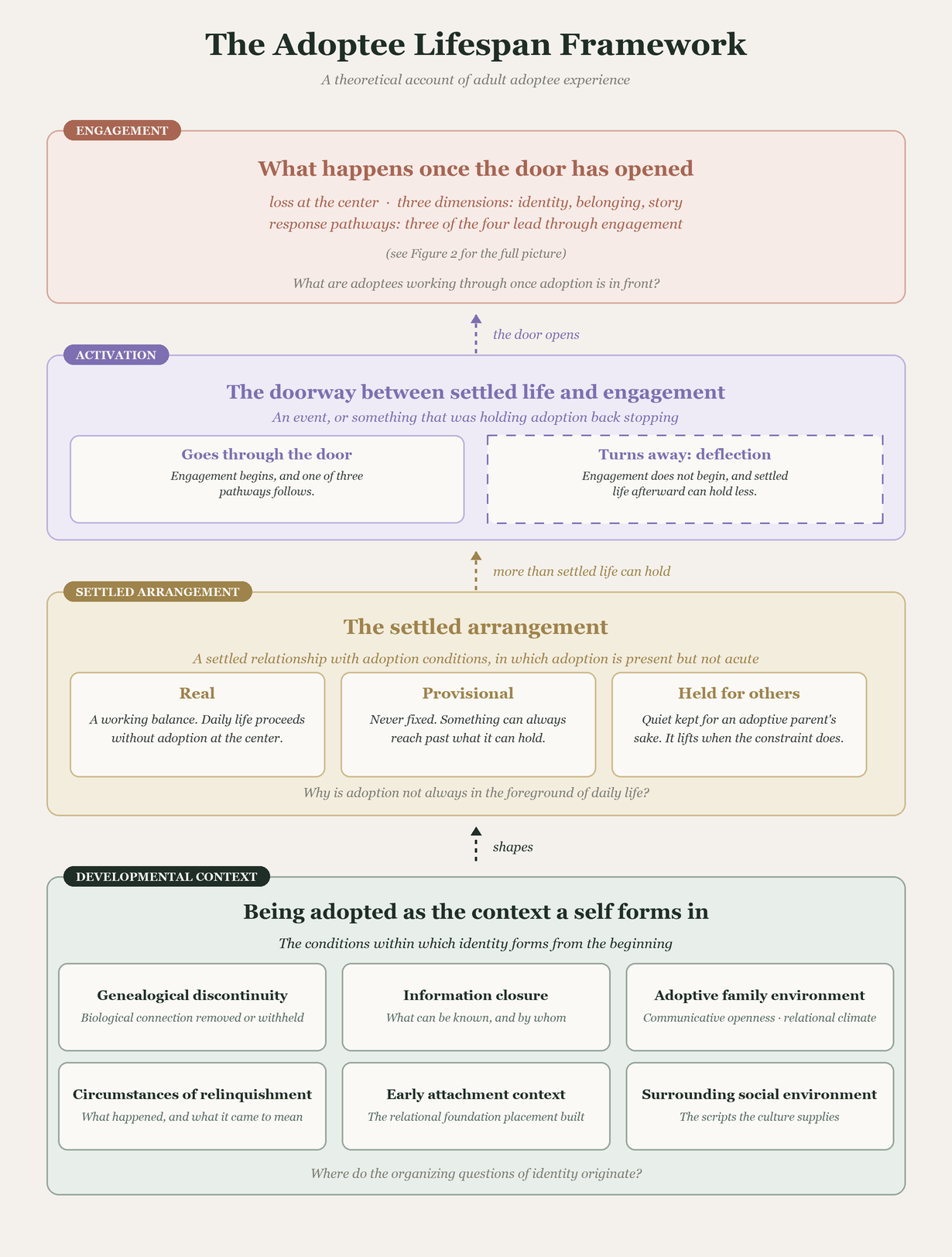
The framework has four parts.
The developmental context. The adoption conditions that shaped the person from the beginning. They arise at different levels: the family (how openly adoption could be discussed), institutions (whether original records can be obtained), and the culture (the gratitude script). Separating what a family did from what a system did is part of reading an adoptee’s history.
The settled arrangement. The working balance most adoptees reach with those conditions, in which adoption is present but not acute. It is not resolution, and it is not denial. The loss is still there, but the person has built a livable relationship with it, and adoption sits in the background. Some settlement is kept for someone else’s sake: an adoptee may not search or ask out of care for an adoptive parent. The framework calls this a protection structure.
Activation. The doorway between settled life and engagement. Activation is a moment, not a state: an event the settled arrangement cannot absorb, or something that was holding adoption back stopping, most often an adoptive parent’s death or an estrangement. The framework calls the second kind activation by removal.
Engagement. What happens once the door has opened. At the center is loss. Around it are three dimensions in which adoptees work on that loss: identity, belonging, and story. The response pathways describe where an activation leads.
Why the Same Event Lands Differently
The framework adds two constructs to explain the variation clinicians see.
Tolerance is how much adoption-related demand a settled arrangement can absorb before it gives way. An event within tolerance is absorbed and life goes on. An event beyond it is an activation. A small event, such as a medical form asking for family history, can do this when tolerance is already low. Tolerance rises with real access to information and confidence in belonging, and falls after a collapse or a deflection. This is different from the clinical “window of tolerance,” which describes arousal in the moment.
Coupling is how tightly identity, belonging, and story are bound together. Where coupling is tight, a question about a birth certificate becomes a question about whether the adoptee belonged in their family. Where it is loose, a hard fact about origins stays a fact about origins. The framework holds that coupling is set in adolescence, when the three dimensions first come to depend on one another, and that it is tightest in families where adoption could only be raised by hurting someone.
Engagement
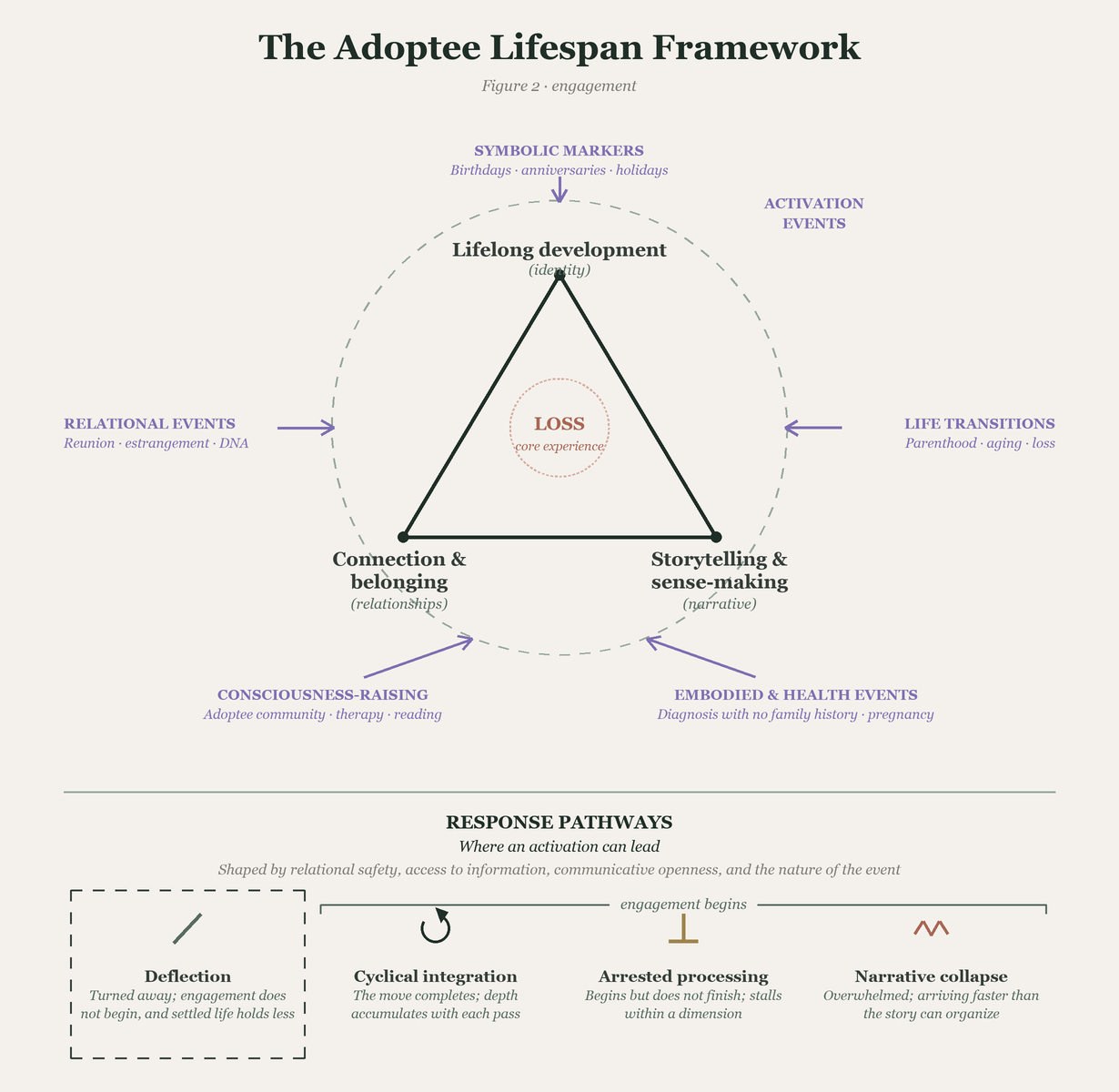
Loss at the center. Adoption removes or withholds what is ordinarily present: connection to the family of origin, an unbroken family line, people who look like you, and firsthand knowledge of where you came from. The framework treats this loss as built into adoption, not as a feeling every adoptee has. What varies is whether and how it is grieved, from substantial grief to none at all. The loss tends not to resolve even when the facts are known, it often goes unrecognized by others, and it returns across a life.
Three dimensions. Identity: who am I, and where did I come from. The pull toward origins belongs here, and it does not depend on how good the adoptive family was. Connection and belonging: where do I belong, who can I trust, and will this connection last. Belonging is the dimension least likely to settle. Story: the account a person builds to hold their life together, and the dimension that holds the other two together.
Activation events. The framework names five categories: symbolic markers (birthdays, adoption anniversaries, family holidays), life transitions (becoming a parent, a death, aging), relational events (reunion, estrangement, a DNA discovery), consciousness-raising encounters (adoptee community, reading, therapy), and embodied and health events (a diagnosis with no family history, pregnancy). Symbolic markers have not been studied as their own category before: dates that carry weight year after year even though nothing new happens on them.
Four response pathways. When an activation happens, the framework describes four places it can lead. Three go through engagement:
- Cyclical integration: the adoptee moves through the dimensions, and their relationship with the loss becomes steadier and more flexible over time, without the loss being resolved.
- Arrested processing: engagement begins but stalls within one dimension.
- Narrative collapse: what surfaces arrives faster than the existing story can hold it, and no new account has formed yet.
The fourth turns away from engagement:
- Deflection: the adoptee turns away before engagement begins and returns to settled life. That life can now hold less than it did, so each deflection makes the next activation harder to absorb.
The pathways are not ranked from healthy to unhealthy. They are four things that can happen to one person under pressure, not four kinds of adoptee, and people move between them over a life. Which one an adoptee takes depends mainly on the conditions of the adoption and the relationships available at the time: relational safety, how openly adoption can be discussed, and access to information.
Scope and Status
The framework was developed with primary attention to domestic, same-race adoption, and it applies most cleanly to infant placement. Kinship, step-parent, foster-to-adopt, transracial, international, and late-discovery adoption change its claims in ways that need their own study. It is offered as a theory to be tested, with stated predictions about what would count against it. The author’s interview study is held separately so that it can test the framework rather than illustrate it.
The Adoptee Lifespan Framework describes how adoption-related meaning-making unfolds across a life, in all its variation. It does not prescribe how anyone should feel about the loss, and it does not assume every adoptee moves toward integration.